• Skip to main content
  • Skip to secondary menu
  • Skip to primary sidebar
emergency preparedness

Simply Preparing

Survival blog for disaster and emergency preparedness.

  • Home
  • About Simply Preparing
  • Beginning Prepping
  • Simple & Inexpensive Prepper Projects

Zombie Soup: Dry Soup Mix For Emergency Prepardness

November 30, 2012 By Prepared Mom

We may earn money or products from the companies mentioned or linked to in this post, including Amazon Affiliate links

I have always loved the story of Stone Soup. A community coming together to chip in and make something out of nothing is how I envision what I hope my community becomes in an emergency scenario. Homemade dry soup mix made from dehydrated vegetables is an excellent part of your emergency food storage plans. Before I get blasted by the people out there who keep prepping 100% OPSEC (operational security), I have built sharing into my prepping in a short term emergency. I feel the best security is to make sure that no one around me is truly in need. AKA a zombie. Prepping things like this simple Zombie Soup will hopefully go a long way in keeping the zombies at bay for at least a little while.

Soup makes me happy. It signifies warmth and comfort. This weekend I put together Zombie Soup preps out of our Thanksgiving leftovers. I now have everything I need dehydrated and ready to throw together a soup in our 36 qt. pot that fits on top of the turkey fryer, which makes an extremely efficient propane boiler that would provide that needed warmth, comfort, and nutrition in an emergency situation to a large group.

To make Zombie Soup you really don’t need a recipe. What you do need is the foresight to put away dehydrated foods in your emergency food preps.

Homemade Dry Soup Mix Ingredients for Zombie Soup:
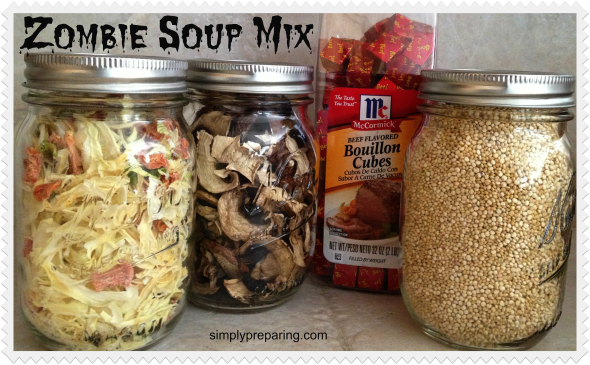
Homemade Dry Soup Mix Ingredients to make Zombie Soup

  • I am a big fan of quinoa for prepping. One cup of cooked quinoa has 222 calories and 8.1 grams of protein. Alternately you could use the prepper staple food- rice or beans or both. If you use quinoa put it in towards the end of your soup cooking cycle as it only takes about 20 minutes in a simmering soup.
  • Dehydrated mushrooms. One Costco sized mushroom container is dehydrated and packed into this Kerr 1 pint mason jar and 1 300 cc oxygen absorber.
  • Dry vegetable soup starter. The third pint size jar has 2 1/2 onions, 1/2 Costco sized bag of carrots, and 6 stocks of celery (had these leftover from Thanksgiving)
  • Bouillon cubes. Sodium and flavor! Or use canned stock. Personally, if I am feeding this to a large crowd I am saving my stock and using cubes with purified water here.

Add as much or as little as you need and want but mark on the outside of the jar what the original volume of the dehydrated foods are. Carrots and celery dehydrate into very small pieces so there is a good deal more there than it appears in its dehydrated state. You could also toss in any meat available.

To save space I could have put the mushrooms in with the soup starter mix, added the bouillon cubes in a small ziplock bag sealed on its on (they have moisture not good for the vegetables) and the quinoa also sealed separately (so it can be cooked less time) all into one foodsaver bag. But to be honest, I can’t find where I hid my last stash of foodsaver bags!


Filed Under: Surviving In Style Tagged With: dehydrated food, food storage, prepping projects, recipes

Reader Interactions

Comments

  1. Patsy Padgett says

    December 5, 2015 at 4:52 am

    I want as many free recipes of meals in a jar. Using fresh or dehydrated ingredients

  2. Amber says

    January 2, 2019 at 12:51 am

    This sounds amazing, I can’t wait to try it Thanks so much

  3. Angie Norheim says

    February 28, 2021 at 11:04 pm

    Great idea! Considering we are bouncing back from a pandemic and greater way to prepare to avoid panic if a second crisis happen. I would love to have your recipes, including of the soup mixes here and instructions how to cook them

Primary Sidebar

Why Worry About Preparing?

Preparedness makes more sense now than ever.

As we move through 2026, it’s clear that the world is shifting in ways many of us can feel — even if we can’t always predict what’s next. In recent years we’ve seen global supply chain disruptions, international conflicts affecting energy and food markets, extreme weather events across multiple continents, cyberattacks on critical infrastructure, economic uncertainty, inflation, and rising costs for everyday essentials.

From global pandemics to geopolitical tensions and natural disasters happening around the world, the message is the same: stability isn’t guaranteed.

Whether or not you believe we’re headed toward a major global reset, there are plenty of everyday realities that make preparedness practical — not extreme. Job loss. Health emergencies. Severe storms. Power outages. Supply shortages. Economic downturns.

Preparedness isn’t about panic.

It’s about positioning your family to respond calmly when life throws the unexpected your way.

We’ve found that the more intentional emergency planning my family does, the less I worry about the big “what ifs.” When you have food storage in place, backup plans for power and water, and practical skills to lean on, uncertainty feels manageable.

That peace of mind is powerful.

Here at Simply Preparing, we share the survival tips, preparedness strategies, and practical systems we’ve learned along the way — from pantry building and food storage to emergency planning and self-reliance skills. Our goal is not to create fear, but to create confidence.

And we hope you’ll join the conversation.

Preparedness is not a solo journey. We all bring different experiences, lessons, and perspectives to the table. Share what you’ve learned. Ask questions. Leave comments. We grow stronger and smarter together.

Now, let’s get started prepping.

Pick a post and begin reading. At the end of every article, the blog will randomly suggest three additional preparedness posts to explore. Set aside just 10 minutes a day to build your knowledge base. Small, consistent steps add up faster than you think.

Because when it comes to preparedness, we’re never truly “done” learning — and we’re never wrong for being ready.

Let’s prepare wisely.

Affiliate Disclosure

We are a participant in the Amazon Services LLC Associates Program, which means we may earn a small commission if you make a purchase—at no additional cost to you. We only recommend products we personally trust and believe are worth having as part of a simple, practical preparedness plan.

Privacy Policy and Cookies

This site uses cookies. Please read our Privacy Policy so you fully understand how we use them.

Copyright © 2025 Indigo Ink, LLC: Simply Preparing Disaster and Emergency Preparedness · WordPress · Log in