As an Amazon Associate, I earn from qualifying purchases. As a #WalmartPartner I may earn a commission from purchases made through my links.
Not many people would argue that water is one of, if not, the most important prep for the beginner to focus on. It’s estimated that you can not survive without water for much more than 3 days. In comparison, the average person can go several weeks without solid food. Though I certainly wouldn’t want to! Let’s do the math to help you calculate what your drinking water storage needs are!
In my opinion, water storage is the first thing a beginning prepper should focus on. But how much do you need? The simple rule of thumb for drinking water is 1 gallon per person per day. Doing the math for a family of 4 that is 4 gallons a day. I plan 2 extra gallons for my two dogs and 1 cat. I also plan to be able to take care of my mom in an emergency bringing our family total to a minimum of 7 gallons per day. If you store that water in 16.9 oz water bottles you need 8 per person per day therefore my family would need 56 bottles a day.
Water Math based on storing 7 gallons a day. Choose whichever form you would like to store it in.
3 days =
- 4.6 water cases (36 16.9 oz bottles)
- 12 2.5 gallon rectangle jugs
- 21 gallon jugs
- 42 2 liters
7 days =
- 10.8 cases
- 21 2.5 gallon rectangle jugs
- 49 gallon jugs
- 98 2 liters
Head starting to spin yet?
10 days =
- 15.5 cases
- 30 2.5 gallon rectangle jugs
- 70 gallon jugs
- 140 2 liters
14 days =
- 21.7 cases
- 42 2.5 gallon rectangle jugs
- 98 gallon jugs
- 196 2 liters
I have plenty of friends who have been in storms (hurricanes and snow) that did not have water for 5 days and electricity for 10. My personal family goal is to have enough water stored for 10 days. After that point, I have started to think of ways to purify water from other sources and have my water heater to drain as well.
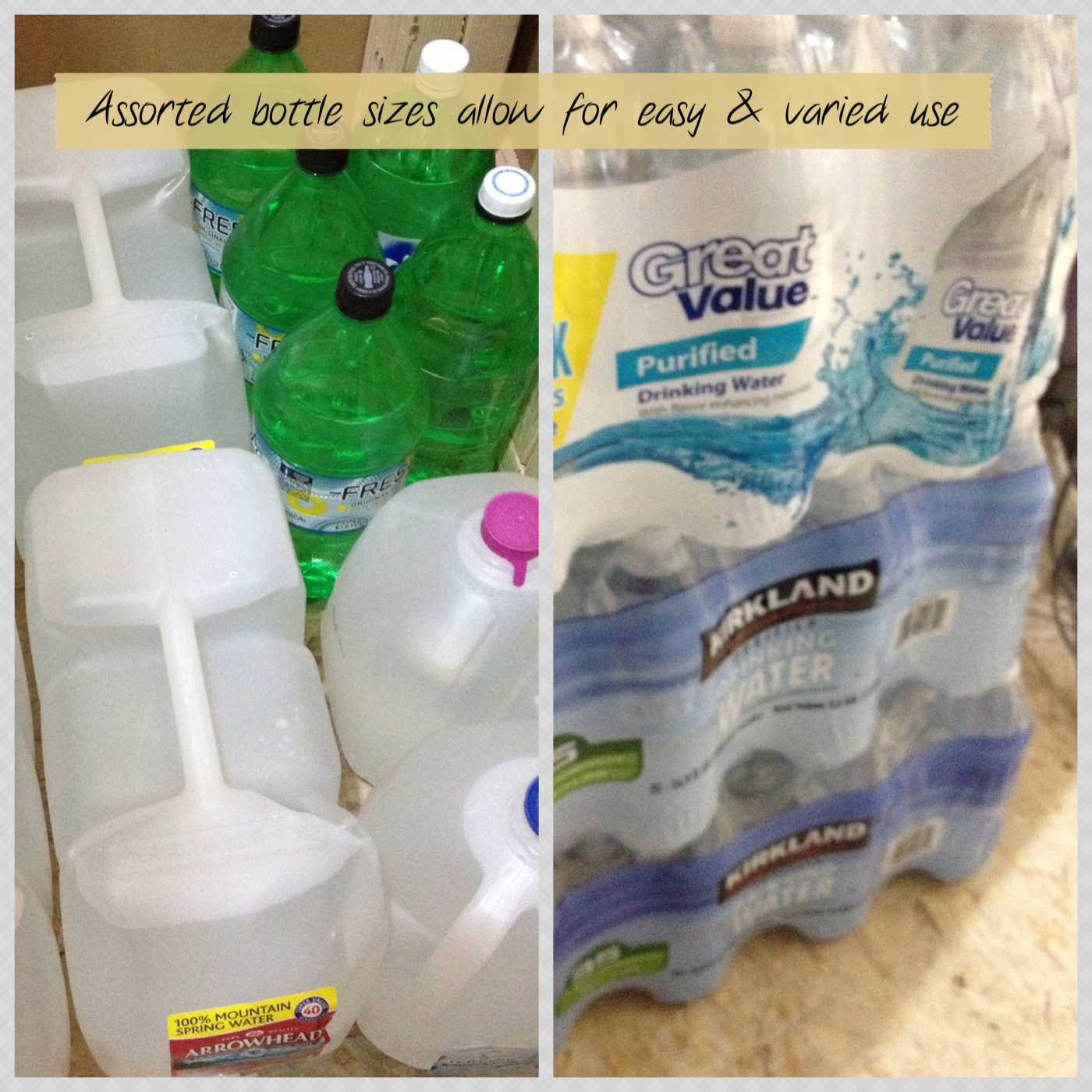
I tend to store water in a variety of containers in combination. One of my favorite tricks is to wash out 2 liter soda bottles with a little bleach water, rinse really well and let them air dry. I refill them with tap water.
Start thinking about what spaces you have to store this water in. Cases do stack well and can use a smaller floorspace footprint. For general cost considerations:
- I get the cases of water mostly at Costco for $3.75. Walmart is $4.25
- I can find the 2.5 gallon rectangles on sale for $1.99 sometimes but $2.50 is average in my area
- Gallon jugs can be anywhere from $.50-$1
- 2 liters I consider “free to me” because I reuse the bottles the pop comes in as a treat for the kids now and then
Using those costs you can expect
- 3 days= $18.75
- 7 days = $41.25
- 10 days = $60
- 14 days = $82.50
I accomplished my goal by promising myself that every time I walked into a store I would buy one thing towards the water storage so it didn’t kill my budget or my back!
Don’t have enough drinking water storage and are facing an emergency?
You need one of these water bobs for each tub and water treatment tabs to add to the water bob to keep it fresh and safe. Additionally, these family lifestraws are perfect for filtering water you are able to collect. You want to have one with your emergency supplies no matter how much water you have stored.
These water bags are what I personally use every time we have a hurricane warning. I make sure to rinse them out with a little bit of bleach water in between uses.
I would love to hear your creative ways to purchase and store water! What tips do you have to share? Or are you completely freaked out at the mass enormity of how much water you would need just to drink?
I don’t have any great ideas but I am going to take yours and make sure to buy one thing of water everytime I go to the store until we are fully stocked.
Do you have any advice on water purification? We are surrounded by three lakes and a stream and would love that on the very very very off chance that I would every need to that I might be able to purify that water.
Yes. Bleach is the easiest. The plain old yucky smelly stuff. You cannot use any of the perfumed or enhanced ones. You can filter it with the cheap coffee filters but you still need to purify it by bleach or boiling it.
This is good advice for purifying water: http://www.doh.wa.gov/Emergencies/EmergencyPreparednessandResponse/Factsheets/WaterPurification.aspx
Don’t forget to PRINT it out 🙂 Thanks for your comment
I use the larger deer park 5 gal water bottles and store them in the attic crawl space. We never use it anyway, and it adds extra incentive to keep in shape when I crawl up and down the ladder. 🙂
I’ve been able to score several 5 gallon containers at the goodwill. I wash them well with bleach solution and store them full in the garage. I don’t count it in my potable water storage but its there for all the extras
We bought 2 – 55 gallon food grade blue storage cans for $35.00 each. I cleaned them up and we bought a new hose that is just for filling them. They sit out in garage. I had read that putting bleach in them was NOT a good idea. It looks like it goes back and forth on that issue. We plan on emptying them once a year by using the water to water garden and flower pots and refilling. I think it will get the two of us through any kind of emergency that we will have.
A lot of people store pool shock to use for them. It doesn’t lose its potency, is cheap and is able to treat larger containers like that with a smaller amount of product.
Buy or make a homemade distilling unit. A wood fire and even brackish water can be made 99.9% pure and bacteria/pathogen free. I’ve seen some made by a Swedish company for under 200$. Mine is a modified stainless pressure cooker with the vent removed and copper pipe from HD like you use for your fridge water supply attached. Make coils out of tubing and run it in a container of cool water to help condense. Water coming out the end is pure. Cool and enjoy.
Buy or make a homemade distilling unit. A wood fire and even brackish water can be made 99.9% pure and bacteria/pathogen free. I’ve seen some made by a Swedish company for under 200$. Mine is a modified stainless pressure cooker with the vent removed and copper pipe from HD like you use for your fridge water supply attached. Make coils out of tubing and run it in a container of cool water to help condense. Water coming out the end is pure. Cool and enjoy.
Thank you for this post. I woke up this morning and decided that I *need* to have my family prepared. Instead of continually thinking about it, I’m finally doing something about it. One of my first thoughts was wondering how much water I would need per person. I was shooting for 3 days, but 10 days seems more… prepared. So, I’m looking at a family of 5 + 2 cats + 2 parents that likely aren’t prepared = 9 peeps to supply water for. Is this 90 gallons for 10 days?
Has anybody else considered mobility? Water weighs about 8 pounds per gallon. Five gallons equals 40 pounds. Also, if a larger container is damaged or contaminated, the whole container may be lost. I use smaller containers so even small children can help move water and only a small container would be lost to a single pin hole.
Catching rain water is free
I would love to know how exactly to make a water distiller. I would use it now as well.
I stock up on cases of water when weekly ad’s show up with a special on them. The past two weeks I’ve found Tom Thumb and Albertson’s have the best deal. A case of 24 at Albertson’s this week is 5 cases for $10. I stocked up more then enough for my family.
We use distilled water every week for coffee and tea and to make ice. I refill the jugs for $.37 each. I just make sure that I rotate them and have a enough for emergencies. We don’t have to worry about drinking old water in an emergency.