
• Skip to main content
  • Skip to secondary menu
  • Skip to primary sidebar
emergency preparedness

Simply Preparing

Survival blog for disaster and emergency preparedness.

  • Home
  • About Simply Preparing
  • Beginning Prepping
  • Simple & Inexpensive Prepper Projects

How To Freeze Eggs

March 22, 2013 By ParkerMama

We may earn money or products from the companies mentioned or linked to in this post, including Amazon Affiliate links

Remember the good old days when eggs used to go on sale for .25 .50 a carton?  In my area we’re  lucky if we see .99 a dozen.   Eggs have gone up in price, which makes knowing how to freeze eggs an excellent skill to master.
How To Freeze Eggs


When To Use Frozen Eggs

Eggs that have been frozen are good for baking and recipes such as waffles and pancakes.   Frozen eggs tend to be a little rubbery for scrambled and other egg dishes, but if you want to give them a try, well, you only live once, right?


How To Freeze Eggs:

1. Crack your eggs into a bowl and whisk them.  You aren’t trying to make them light and fluffy with lots of air, as a matter of fact, the less air the better.  You just want the white and yolk well mixed.

2. Put about 3 T of your egg mixture into an ice cube tray.  I used *this post contains affiliate links baby food trays because I know that they are BPA free.

3.  Stick your tray of eggs into the freezer and let them freeze.
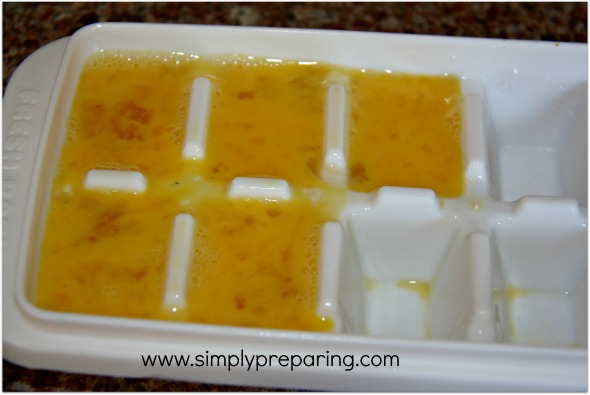
Freezing eggs in ice cube trays

4.  After they are frozen, pop them out double bag them zip-lock bags, and stick them back into the freezer.  DATE YOUR BAG and write down HOW MANY CUBES MAKE AN EGG.  You may THINK you will remember this, but you won’t.  Trust me. (ahem)  Eggs are good for about 6 months when packaged this way.

These eggs should last up to a year in your freezer if you use your Food Saver and seal them in Food Saver bags. 

5. Speaking of how many cubes equal and egg…..two ice cubes is about 1 egg.  Just remember how many eggs you mix, and how many ice cube trays it fills up to figure out the cube per egg ratio.

Defrost as many ice cube eggs as you need for your recipe.  Don’t microwave them to defrost them because you will start to cook them.  Use your defrosted eggs right away.

Freeze Eggs In Muffin Tins

I used to do this in tin muffin containers.  But I now use these silicone muffin pans and will NEVER go back.  So much easier to pop out!  I think you’ll love them too.

1.  Crack eggs into bowl
2. Lightly scramble eggs
3. Pour into your silicone muffin tins and freeze!

Freeze Eggs In Ready To Eat Breakfast Meals

My family enjoys being able to grab a breakfast burrito or egg muffins out of the freezer, pop it in the microwave to warm it up, and head out for the day.  Don’t forget breakfast casseroles, like this one from Pocket Change Gourmet 

Shelf Stable Eggs

Freezing eggs not really your thing?  Worry not!  There excellent shelf stable eggs available in both powdered eggs and freeze dried eggs are a great choice.    Easy to add to your baking or scramble up for a quick breakfast!  Another family favorite are the Scrambled Eggs With Bacon from Mountain House.   Remember, eggs are an important part of both your long term, and short term food storage plan.
Yes! You CAN freeze eggs! Here's how!

Do you freeze eggs? How do you preserve your surplus of eggs?

Filed Under: Food Storage Tagged With: 3 month food storage plan, eggs, Food Saver, freezer meals, prepping, seasonal preps

About ParkerMama

Tammy is a mom to 6 wonderful kids, including Parker, who came with an extra chromosome! She is passionate about special needs advocacy, living within her means, and preparing for an uncertain future. Tammy's main blog is Praying For Parker. Make sure to visit her there as well!

Reader Interactions

Comments

  1. Suzie says

    May 14, 2013 at 7:05 pm

    Ha I would have never thought of freezing eggs, but it seems simple enough.

  2. Deborah says

    December 1, 2016 at 6:11 pm

    I’ve never thought of freezing eggs!

  3. Maverick says

    April 17, 2018 at 1:52 am

    Do you have to scramble them? Wondering if you could just crack an egg into a muffin tin as stated above the go straight from the freezer to boiling water for a poached egg. Would be interesting to try.

    • ParkerMama says

      April 17, 2018 at 3:35 am

      I bet you could just crack an egg into a tin. If nothing else, try it with a few and see!

Primary Sidebar

Why Worry About Preparing?

Preparedness makes more sense now than ever.

As we move through 2026, it’s clear that the world is shifting in ways many of us can feel — even if we can’t always predict what’s next. In recent years we’ve seen global supply chain disruptions, international conflicts affecting energy and food markets, extreme weather events across multiple continents, cyberattacks on critical infrastructure, economic uncertainty, inflation, and rising costs for everyday essentials.

From global pandemics to geopolitical tensions and natural disasters happening around the world, the message is the same: stability isn’t guaranteed.

Whether or not you believe we’re headed toward a major global reset, there are plenty of everyday realities that make preparedness practical — not extreme. Job loss. Health emergencies. Severe storms. Power outages. Supply shortages. Economic downturns.

Preparedness isn’t about panic.

It’s about positioning your family to respond calmly when life throws the unexpected your way.

We’ve found that the more intentional emergency planning my family does, the less I worry about the big “what ifs.” When you have food storage in place, backup plans for power and water, and practical skills to lean on, uncertainty feels manageable.

That peace of mind is powerful.

Here at Simply Preparing, we share the survival tips, preparedness strategies, and practical systems we’ve learned along the way — from pantry building and food storage to emergency planning and self-reliance skills. Our goal is not to create fear, but to create confidence.

And we hope you’ll join the conversation.

Preparedness is not a solo journey. We all bring different experiences, lessons, and perspectives to the table. Share what you’ve learned. Ask questions. Leave comments. We grow stronger and smarter together.

Now, let’s get started prepping.

Pick a post and begin reading. At the end of every article, the blog will randomly suggest three additional preparedness posts to explore. Set aside just 10 minutes a day to build your knowledge base. Small, consistent steps add up faster than you think.

Because when it comes to preparedness, we’re never truly “done” learning — and we’re never wrong for being ready.

Let’s prepare wisely.

Affiliate Disclosure

We are a participant in the Amazon Services LLC Associates Program, which means we may earn a small commission if you make a purchase—at no additional cost to you. We only recommend products we personally trust and believe are worth having as part of a simple, practical preparedness plan.

Privacy Policy and Cookies

This site uses cookies. Please read our Privacy Policy so you fully understand how we use them.

Copyright © 2025 Indigo Ink, LLC: Simply Preparing Disaster and Emergency Preparedness · WordPress · Log in